Hey there,
Today I want to dive into one of the most repeated statistics in this industry - and explain what it actually means. After 20+ years operating self-storage and building Cedar Creek Capital from the ground up through multiple market cycles, I’ve learned that the most expensive mistakes investors make don’t come from bad assets. They come from misunderstood risk.
Let’s look at the data - all of it.
The 0.15% Default Rate: What It Really Means
The self-storage industry has carried one statistic as a badge of honor for years: default rates ranging from 0.11% to 0.15% - among the lowest in all of commercial real estate.
At first glance, that number sounds extraordinarily reassuring, especially compared to other asset classes that have recently faced refinancing pressure and rising delinquencies. And it is a meaningful number. Self-storage has genuine structural advantages, and stabilized, well-operated facilities have historically produced strong and consistent cash flows.
But the real issue isn’t the statistic itself. It’s how people interpret it.
After investing through multiple real estate cycles and building a self-storage portfolio across 7 states with 31+ facilities, I still believe storage is one of the strongest asset classes available to disciplined operators. But I’ve also learned that misunderstanding risk is where investors get hurt - and this widely repeated headline figure has created one of the biggest misconceptions in the industry.
Where the Number Actually Comes From
The commonly cited distress data primarily comes from CMBS loans - commercial mortgage-backed securities. Because CMBS loans are pooled, securitized, and traded in public markets, their delinquency and default statistics are transparent and easy to track. That visibility gives the number credibility.
However, CMBS loans represent only a small slice of the storage universe - roughly 12% of the industry.
That 12% largely consists of institutional-grade properties in major metropolitan areas, operated by experienced teams with structured, non-recourse financing. These are typically stabilized, cash-flowing assets that meet strict underwriting criteria. They represent the most professionally managed, best-capitalized segment of the entire market.
The remaining majority of storage properties - well over 80% - operate with financing from local banks, credit unions, private lenders, and construction loans. These loans are not publicly reported. Their performance does not appear in national CMBS databases.
When headlines cite a 0.15% default rate, they are referencing the visible 12% and implicitly applying it to the entire industry. That would be like analyzing only the largest, most stable companies in a sector and assuming the data reflects every small operator nationwide.

The Development Wave That Changed the Equation
Between 2019 and 2021, self-storage development surged across the country. Capital was abundant, interest rates were historically low, and transaction volume was setting records. Many developers built facilities with the intention of obtaining a certificate of occupancy and selling into an aggressive acquisition market rather than operating long term.
Then the financial landscape shifted.
Interest rates rose sharply - near-zero to 5%+ in 18 months, the fastest interest rate increase in Federal Reserve history. Occupancy softened in many markets as historic new supply delivery hit self-storage markets simultaneously across the country. In several regions, rental rates declined more significantly than they did during the 2008 financial crisis. Projects underwritten in a low-rate, high-demand environment began delivering into a market with fundamentally different conditions.
Because development takes years from ground-break to stabilization, many of those projects reached completion just as conditions tightened. Construction loans matured, owners attempted to refinance into permanent debt, and discovered their projected debt coverage ratios no longer worked. Rents were below pro forma. Stabilization timelines were longer than anticipated. Lenders required additional equity to close the gap.
Much of this stress occurred entirely outside the CMBS market - in the invisible 80%.

Over the past year, Cedar Creek Capital has acquired hundreds of thousands of net rentable square feet from owners who were unable to refinance or recapitalize their projects. In several cases, we purchased high-quality assets in strong markets at discounts approaching 40% below replacement cost. The buildings were solid. The markets were sound. The issue was entirely the capital stack.
None of that distress shows up in the 0.15% headline.
Risk Was Never Eliminated. It Was Mispriced.
Self-storage has genuine structural advantages. Stabilized facilities generate strong margins, and operators can adjust pricing relatively quickly compared to most other asset classes. The operational flexibility is real, and it matters.
But structural advantages do not eliminate risk. They change its character.
When investors enter an asset class believing default is nearly nonexistent, the behavior that follows is predictable: leverage becomes more aggressive, development feels safer than it is, and underwriting assumptions stretch to justify pricing. The risk doesn’t disappear - it accumulates in structures that won’t be tested until conditions change.
During the 2020–2022 period, enthusiasm was widespread. Cap rates compressed aggressively, transaction volume surged, and new supply expanded rapidly. It felt stable. It looked stable. In reality, that was precisely when risk was most elevated.
Cycles have a way of inverting perception. At the top, investors underestimate risk and overestimate upside. At the bottom, they overestimate risk and underestimate long-term opportunity. Understanding where you are in that cycle is just as important as understanding supply and demand.
This dynamic is not unique to self-storage. It plays out in every asset class, in every cycle. What is unique to self-storage is that the headline default rate gave investors a specific number to point to as evidence that the rules were different here. They weren’t. Capital structure discipline and responsible asset management matter in self-storage exactly as much as they do anywhere else.
Why Today’s Environment Looks Different
Transaction volume remains well below peak levels. Sellers have gradually adjusted expectations, and many speculative developers have stepped back from new projects. Financing standards are tighter, and underwriting assumptions are more conservative across the board.
At the same time, development starts have slowed considerably. This matters because supply in self-storage operates with a multi-year lag. Projects initiated today may not deliver for three to four years. When new construction slows meaningfully, the impact on the market is not immediate - but it is inevitable.
When new supply stops coming and existing demand stabilizes or grows even modestly, occupancy and rental rates strengthen in an environment with limited new competition. That dynamic contributed significantly to the wealth creation that followed the 2008 financial crisis. Operating since before that period, Cedar Creek Capital acquired assets when sentiment was cautious, capital was tight, and competition was limited. The constrained development pipeline that followed created a favorable operating environment once broader conditions improved.
Today’s cycle is not identical to 2008, but certain structural parallels are emerging: development has slowed, financing is more disciplined, buyers are selective, and sellers have become more realistic about valuation.
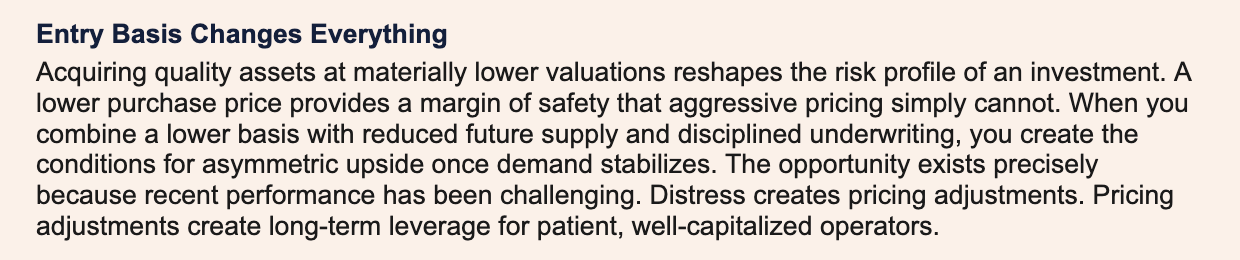
Most importantly, the entry basis has adjusted.
How 20 Years of Cycles Changes How You Think
There is a meaningful difference between operators who have modeled market cycles and operators who have lived through them. A track record forged under real market pressure - not just modeled against historical scenarios - produces a different kind of decision-making.
Operating since before 2008 means I’ve navigated the worst commercial real estate environment in a generation, survived COVID with zero investor losses, and operated through the 2022–2024 rate shock when even large public REITs reported significant occupancy and revenue pressure. Each cycle reinforces the same lessons:
-
Capital protection is the first priority. Returns follow from not losing capital. Operators who protect principal in down markets are the ones still in business to capture the recovery.
-
The capital stack determines your options. A well-structured capital stack - conservative leverage, personal guarantees, appropriate reserves - gives you the ability to hold through downturns, acquire at the bottom, and refinance on your own timeline. A poorly structured one gives market conditions the ability to make your decisions for you.
-
Skin in the game changes decisions. Operators who are the largest investor in their own deals make different choices than those who earn fees regardless of results. When principals profit only from capital performance, every operational decision is aligned with investor outcomes.
-
Covering shortfalls is the test. When markets turn, the question is not whether challenges will arise - they always do. The question is who absorbs them. Principals absorbing losses before investors do is not just an ethical position. It is the structural expression of alignment.
At Cedar Creek Capital, these aren’t principles we’ve adopted recently. They are the operating philosophy that has produced a 20+ year track record of zero capital calls and zero investor capital losses across all funds and all market cycles. We have bridged investor shortfalls with personal capital. We have chosen capital preservation over optics. We have been full-cycle operators in self-storage since before it was an institutional asset class.
A track record is only meaningful if it was earned in hard markets. Ours was. The operators who thrive through cycles aren’t the ones who predicted the cycle. They’re the ones whose structure gave them options when it arrived.
What Full-Cycle Operators Are Built Differently Around
The 0.15% headline tells you nothing about how an operator is actually built - what disciplines they’ve developed, what stress they’ve absorbed, and whether their structure holds up when conditions change. After 20+ years in this business, here is what I’ve observed separates the operators still standing after every cycle from the ones who had a great run in good markets:
-
Track record through hard markets, not just the peak. Any operation looks functional in 2020–2021. The real test is what happened through 2008, through COVID, and through the 2022–2024 rate environment. A track record forged under real market pressure tells a fundamentally different story than one built in a bull market.
-
No capital calls. The discipline to never call additional capital from partners is a direct reflection of leverage decisions made at origination - before conditions required anything of the capital structure. In 20+ years of operation across multiple market cycles, Cedar Creek Capital has never issued a capital call and has never caused an investor to lose capital. That record is built deal by deal, at underwriting, not rescued after the fact.
- Real skin in the game. Operators who carry the majority of their own capital in their deals make different decisions than those who earn fees regardless of results. On Cedar Creek’s four most recent deals, GP co-investment exceeds 60% - Cedar Creek Capital is the largest investor in its own funds. When your own capital is the biggest position, every operational decision has a different weight.
-
Personal liability on the debt. I personally guarantee every note in the Cedar Creek portfolio. Personal liability changes the calculus on leverage in ways that entity-level protection simply does not. The operator who signs personally underwrites more carefully, holds more conservatively, and manages more attentively than one who is insulated from the downside.
-
Performance-only compensation. The only profits Cedar Creek Capital’s principals have ever received came from the performance of their own invested capital - the same capital at risk alongside every partner in the deal. Operators compensated only from results make different long-term decisions than those extracting fees regardless of outcomes.
-
Organizational depth. The test of a real operating platform is what happens when the founder isn’t in the room. Cedar Creek Capital runs on 80+ full-time employees across a fully integrated platform. The infrastructure operates independently of any single individual - because a business that depends on one person isn’t a business, it’s a job.

The Competitive Advantage That’s Always Available
The purpose of understanding where the default statistic originates is not to discourage anyone from investing in self-storage. It is to remove complacency and replace it with clarity.
No one knows the exact default rate across the entire storage industry because the majority of loans are not publicly visible. What we do know is that the headline figure represents a carefully selected subset of the market - and that the segment of the market not captured in that figure has experienced meaningful stress over the past two years.
When you understand that, you stop making decisions based on incomplete data. You start evaluating capital structures, loan maturities, supply pipelines, and operator track records more carefully. You build liquidity. You avoid over-leveraging at cycle peaks. You ask hard questions of every sponsor before you commit capital.
Self-storage remains, in my view, one of the most attractive commercial real estate asset classes for disciplined operators and investors. It offers genuine operational flexibility, resilient demand drivers, and strong margins when managed correctly.
But durable wealth in self-storage - as in any asset class - is not built by repeating industry talking points. It is built by studying the mechanics beneath the headlines and positioning capital accordingly.
Right now, Cedar Creek Capital is acquiring selectively, with conservative underwriting, a long-term horizon, and the same capital discipline that has produced 20+ years of zero capital calls and zero investor losses. Not because we believe risk has disappeared, but because we believe risk is now more accurately priced than it has been in years.
In every cycle, clarity separates those who react emotionally from those who act strategically.
Watch the full Youtube video breakdown here.
See you next week,
AJ Osborne